While science fiction often showcases technology, often very front and center, there’s often a lot of additional tech in the world that goes barely remarked. We can call this ancillary technology, in a way that offhand mentions of tech in a sci-fi book often include – one-liners that function as set dressing that end up becoming prescient for future real-world innovations.
We see examples of this throughout science fiction, from the simple screens, tricorders, and automatic doors of Star Trek, to the various uni-functional droids in the Star Wars universe, to the aforementioned one-liners in cyberpunk novels that end up becoming part of our daily lives: think smartphones and credit cards and dashboard cameras. There’s some amazing stuff there hidden between the margins.
Ancillary tech is a corollary to the idea of the technological sublime. In his work on the electrification of America, David E. Nye noted how the technology really gained traction when it disappeared behind the walls, when it became infrastructure that would just reliably work with the flick of a switch. This sublimation of the tech into the built environment evokes the dual meaning of the root word: it becomes awesome (or awful, I guess. Either way there’s lots of awe involved in the sublime). This is similar to the Albert Borgmann’s device paradigm, where our relations to our tools and tech changes when it goes from being a thing we do to a device where we push a button (frex).
This idea of Ancillary Tech popped up again for my during a recent re-read of Virtual Light (Gibson, 1993), as we noted in a recent issue of the Newsletter. I noticed the text had several examples of tech in the marginalia, things like one-time credit cards, rear view cameras in vehicles, led displays on vehicles and all kinds of surfaces, and several other besides. Many of these are things where we can see a version of it in our daily lives.
Ancillary Tech is all around us in the media. If you see some examples of Ancillary Tech, let me know your fave. 🙂
There will be some spoilers in this review and commentary about the recent film.
Do you ever go to a theatre and see a movie with incredible potential but it doesn’t quite reach it, it doesn’t take that next step to get where it needs to be to reach that level of greatness?
Mickey 17 (2025) movie poster
That was my experience with Mickey 17 (2025), a movie I enjoyed, with a great concept and cast, and had so many things go for it, but it felt like it was holding back, and this made it a “smaller” film than it could have been, if it really wanted to take some of the ideas that it was exploring up to the next level.
The political commentary in the film was on the nose, which is remarkable given how long ago this would have likely been in pre-production* and development to nail that, but it seems almost restrained compared to current events that we’re dealing with right now (in April of 2025).
We also see continuing elements of class and social commentary that Bong Joon Ho has had in his other films like Parasite (2019) and Snowpiercer (2013), and there’s a lot of similarities with Snowpiercer in this film. They’re both deeply chilling movie in the same way, and this only is in part due to the winter environment that’s an existential threat that forces humanity in on itself. Hmmm. Probably a paper there needed to unpack all that.
However, the part where the movie hit a wall for me is with the implications of the 3D printing tech and the memory storage: it didn’t take it far enough and explore what it could actually do – it took it to a certain point and just stopped, which is unfortunate, as other movies with similar themes like Edge of Tomorrow (2014) or Westworld (1973) and Futureworld (1976) (or the 2016 HBO series) where we have that printing technology going on explored it better, and I think that speaks to some of the films limitations.
One of the ways Mickey 17 falls short is in the portrayal of the 3D-printing technology and the way it is integrated within society. The tech itself comes across as both silly and kinda dorky in the way it’s implemented, with the slow emergence like from a dot matrix printer in the 1990s to the fully-completed form. This is where Leeloo’s build in The Fifth Element (1997) or the hosts emerging from the vat in Westworld (2016) feel more fully realized. The silliness of the process works, in so far that it also highlight the somewhat bizarre way that this future society treats the implications of this tech. So many questions remain poorly answered by the film: why only one person per ship as an Expendable? Why not multiples for each role on the ship (or at least for the combat, exploration, and scout crews?) Why limit what is essentially nigh-immortality to a very limited underclass? Why would the ultra-wealthy not jump on this very tech? (Though this last point is kinda hinted at in the dream sequence in the epilogue). This silliness brings Mickey 17 more in line with other films like Prometheus (2012), and to be honest, I’ve never really enjoyed movies that kick around the idiot ball.
Some of this is answered, though not to my satisfaction, in the presentation of the Expendables and Multiples in the film. The religious proscription against having more than one, and the way they are treated. And of course, the use of the gun as the final commitment to the process (similar to dog in Kingsman (2015)) may be a bridge too far, though one that the crews of Starfleet have long since overcome. (The argument about whether the transporter kills the user or not having gone on for ages.) If one is already on the upper tier of society, would one be willing to risk it all to achieve this pseudo-immortality?
It might be too much to give up, as the process isn’t exactly perfect. We learn in the second act that there are variations in various duplicates, as they emerge from the printer. Whether this is due to the somewhat less that rigorous process of printing and downloading that occurs by the medical team – who remind one of a collection of grad students in a lab, rather than the most top-notch team out there – or due to some natural variations in the printing process is unexplained. There is a lot of difference in the repetition, and this variance might not be appealing to the ultra-wealthy that would be demanding a greater degree to fidelity in the transfers, much as was seen in the aforementioned Westworld in its later seasons.
Ultimately Mickey 17 is a love story. Despite the difference in each iteration of the various Mickeys, each one of them is loved by Nasha, who he loves in turn. Their meet cute happens early in the movie, and it’s love at first site, a love that endures through each reprinting of Mickey. His love for her is constant (and she does change and grow through the movie too – the role she plays at the end of the film is not who we see at the beginning – as is her love for him, throughout all the different foibles and flaws of the many personalities that are printed.
Though there some throughlines, some continuity in the bedrock personality, which is why Mickey 18 makes the sacrifice play late in the film, despite the wildly different personality from 17. Props to Robert Pattinson for pulling off making the same character feel different in Mickey’s varied iterations.
Final thoughts: Mickey 17 is well crafted, there isn’t any misses in the production aspects of it, though some of the satire misses due to the low-key nature of it. I want to see the Luc Besson version of Mickey 17, that takes the premise and goes all out.
*: apparently this is an adaptation**, which I had heard about going in but hadn’t checked the book out. Also, the book was published in 2022, and adapted shortly after, and was originally delayed in release from it’s original set date in 2024. So the political stuff is even more poignant, or perhaps sadly, more eternal.
**: also, in looking at the wiki after writing the above, the short story was also an exploration of the Star Trek teleporter paradox, so… hmm, yeah.
On November 17th, 2024, a rather special digital short was released on YouTube for Star Trek fans:
Celebrating the 30th anniversary of the release of Star Trek: Generations, 765874 – Unification is a silent clip produced for the Apple Vision Pro.
The explanation can be seen on the the OTOY website here: https://home.otoy.com/unification/ OTOY is a software company that produces the OctaneRender Studio and cloud rendering solutions for CGI and digital imaging.
Working within the software suite, the producers used “digital prosthetics” on top of the actors who were filmed in costume to recreate the Kirk and Spock as portrayed by William Shatner and Leonard Nimoy during the films.
So while being a tribute, the short is also a product demo and advertisement for the de-aging technology that can be used by other filmmakers. This commercial aspect of the project doesn’t diminish the effect of the short, but I felt it worth mentioning.
We spoke a lot earlier this year on the effect of Nostalgia, and much of that was via the lens of Star Trek, placing the various series of the streaming era on a curve. 765874 captures much of what we’re talking about. If you have no attachment or knowledge of the characters, no nostalgia for them, it could be largely devoid of meaning. It is the history of those characters than brings the emotional weight to the piece.
Still, if you have connection to those characters at all, no matter how tangential (like me), then it’s worth checking out.
This is part 2 of the Nostalgia Curve; part 1 and part 3 are already posted.*
In the first post of this series we described how nostalgia functions as a factor in the calculus of content production, how it feeds into the algorithm of whether something gets made. So that leads to the question: how to determine the value of nostalgia.
Now, I’m not particularly privy to the internal calculations of Hollywood finance, but it might be worth plotting those out, comparing released titles in a franchise versus the real (or subjective) value they held for the franchise owner. For illustrative purposes, we’ll use the Star Trek series released during the streaming era. Those include the following:
Star Trek Discovery (2017-2024): a prequel series with an all-new cast, and the first Star Trek series in 10 years, with a premiere on regular television before the rest of the episodes were released via streaming. There was some contention over earlier episodes, but it received high praise, and was noted as a driver of subscriptions.
Star Trek: Picard (2020-2023): a series following the captain of the Enterprise from Star Trek: the Next Generation, with eventual appearances of other cast members from that series. It received critical acclaim, with reviews generally around the 80% range, and it was a driver of subscriptions to the Paramount+ online channel.
Star Trek: Lower Decks (2020-ongoing): an adult animated series based on a premise from a Star Trek: the Next Generation episode from 1994, following the misadventures of low-ranked characters. Lower Decks has gathered critical praise and generally positive reviews, but it doesn’t appear to be the driver of the ongoing Star Trek stories in the way that the other series are.
Star Trek: Prodigy (2021-ongoing): a computer animated Star Trek show aimed at children, with a tie-in to Star Trek: Voyager. Appearing on Nickelodeon, it was cancelled after one season despite critical praise and an Emmy, and picked up by Netflix for the second season, and possibly more.
Star Trek: Strange New Worlds (2022-ongoing): follows the Enterprise before Kirk became the captain and the events depicted in Star Trek: the Original Series (1966-1969). Feeling in some ways like a direct homage of the original show, it has received accolades, with a third season in production and a fourth ordered.
For all these series, we can see a number of commonalities: varying degrees of nostalgia, with some series tying more directly to past properties and the extended universe; there is a difficultly judging the impact as the streaming services are reticent to provide their viewership data; and tailoring each show to appeal to different segments of the larger Star Trek fandom.
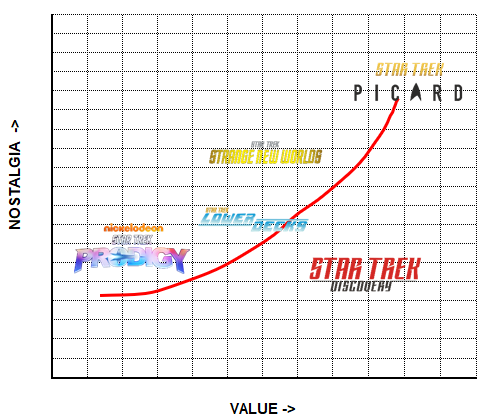
Plotting these series out, we start to see what the curve looks like:
There are several takeaways:
Value is subjective; absent real data on the viewership, it can be tough to place the titles on the curve, or to judge their impact
Value is relative; for a show like Prodigy, it wasn’t worth it for Nickelodeon, but Netflix was more than happy to pick up and release the show.
Nostalgia is also subjective, but the more closely tied a property is to what has gone before – the trappings and tropes of the extended universe – the more constrained the creators can be in what they can make.
But there are other approaches we can take: value isn’t the only way to rate nostalgia. Perhaps point three can give us a clue: comparing the nostalgia a show evokes versus the novelty that it approaches the subject with. Let’s take a look at the Shape of that Curve in our next post.
* Disclaimer: due to the vagaries of blogging and this being an exercise in “thinking through writing”, this piece (part 2) ended up getting posted after part 3 on “the Shape of the Curve“. Whoops! My bad. Hope it didn’t cause too much confusion.
Lost in all the excitement of this new idea, I realize I forgot to actually show you what the curve looks like. Whoops. Let’s rectify that.
The first challenge is that the curve is still under development; this is all a work in progress, an act of thinking by writing, if you will. The second challenge is that my skills in data science and graphic design are somewhat lacking. (The overall website design should have been a hint). Nevertheless, we’ll try our best; though we’re currently stuck somewhere between MS Paint and R.
For the sake of example, we’ll use the Star Trek series released during the Streaming Era that we mentioned in our initial post as data points along the curve. The shape of the curve will depend on some choices we make. Let’s see what our options look like.
Curve 1: Nostalgia vs. Novelty
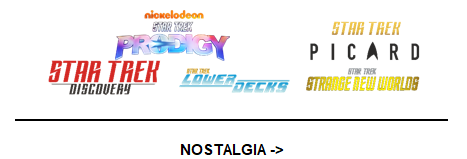
If we picture series (or media titles, generally) as containing elements that evoke either Nostalgia in the audience, then we can quantify* that in some form. This degree of nostalgia would exist along a continuum, where we can say something is more or less nostalgic relative to other titles in the brand. With the Star Trek Streaming Titles (ST:ST for short), that continuum might look something like this:
Star Trek is not unique in long-running media titles, in that they all trade in nostalgia to a degree, but here we see titles like Picard and Strange New Worlds leaning heavily on other characters, settings, and aesthetics to bring the audience on board, where as Discovery and Prodigy are further removed.
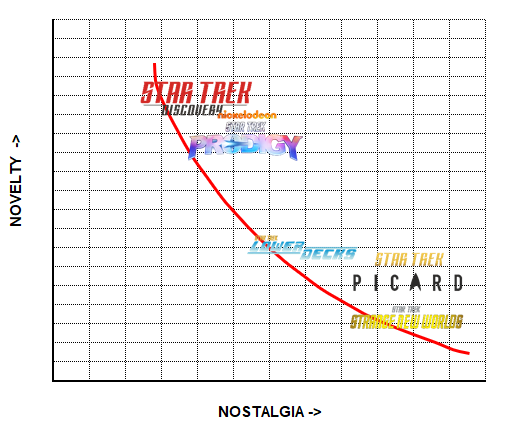
This is useful, but a more complete look at Nostalgia might contrast this with Novelty, where something new is introduced to the setting or the larger universe, and the traditional tropes and aesthetics of the universe are muted. Here we can see that Nostalgia isn’t absent with the more Novel titles, but their focus on Novelty moves them further along the curve.
However, this isn’t the only way we can picture the Curve, so it may be useful to lay out some alternative formulations.
Curve 2: Real vs Imagined
One way to think about Nostalgia is to think about the extent it is real or simply imagined, on the part of the audience. (I guess that creatives and other content producers can be part of this audience as well, as it’s not uncommon for the producers to be fans or marks for the product, but that’s an aside for a later date.)
Real nostalgia would be the fans longing for something that was actually produced (and published) in the past. It can be cited, looked at, enjoyed. Imagined nostalgia would be for something that the audience think they have seen, but never actually happened. For a more recent example, we could look deeper at some of the elements in Deadpool & Wolverine, like the yellow costume, or Gambit’s appearance in the film.
Neither of them actually happened before; they’re both adaptations of elements that have shown up previously in other media. Granted, the nature of transmedia storytelling necessarily means that there is going to be a lot of adaptation going around. The audience is doing a lot of the lifting here, getting something (close to) what they think they wanted.
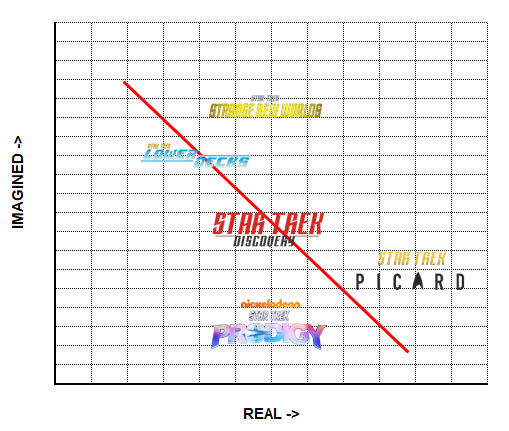
Mapping real v. imagined nostalgia, this is what the ST:ST curve would look like:
Less of a curve, and more of a straight slope downhill. Hmm. But wait, in the previous post we also talked about the “incepted” nostalgia, that which was created by the content producers to evoke nostalgia. What does that look like for the ST:ST titles?
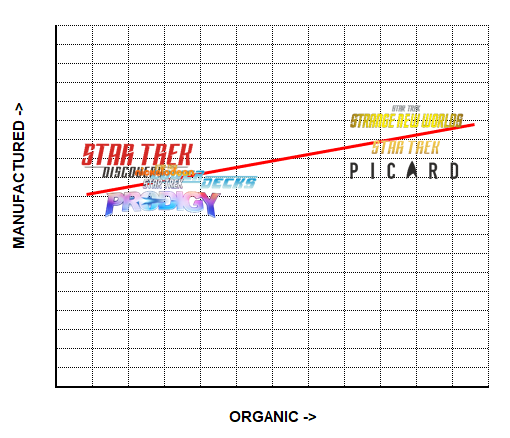
Curve 3: Organic vs. Manufactured
Organic nostalgia is that experienced by the audience on their own. It is somewhat inherent in the thing. Again, this can occur due to elements, aesthetics, and tropes of the shared universe, but it is on the audience. Organic nostalgia is also related to curve 2, as both real and imagined nostalgia could count as “organic”, having been experienced by the audience.
Manufactured nostalgia is that incepted form. Something brought in for the express purpose of pushing the audience’s nostalgia button. And Star Trek as a franchise pushes this button hard, with each series relying on it to some degree.
So much so that “series” may not be the right analytic unit for this. It may be worthwhile to go inter- or intra- series for the analysis, comparing the series on an episodic basis, or comparing the series versus other series for other franchises.
Current Examples
What is driving the current trend? The summer box office seems to be thriving on it. This series of posts was originally spawned by the release of Deadpool & Wolverine in late July 2024, and as I’m working on the next part Alien: Romulus has been released, drawing heavily on James Cameron’s (1986) Aliens, so much so that people are pointing out shot-for-shot scene comparisons where the A:R directly compares. This happened in D&W as well, with fight choreography coming directly from Sam Raimi’s (2002) Spider-Man, among many other elements.
And these movies are doing well, with positive word of mouth circulating about each film. So something is in the air. What else is pushing us along the Nostalgia Curve?