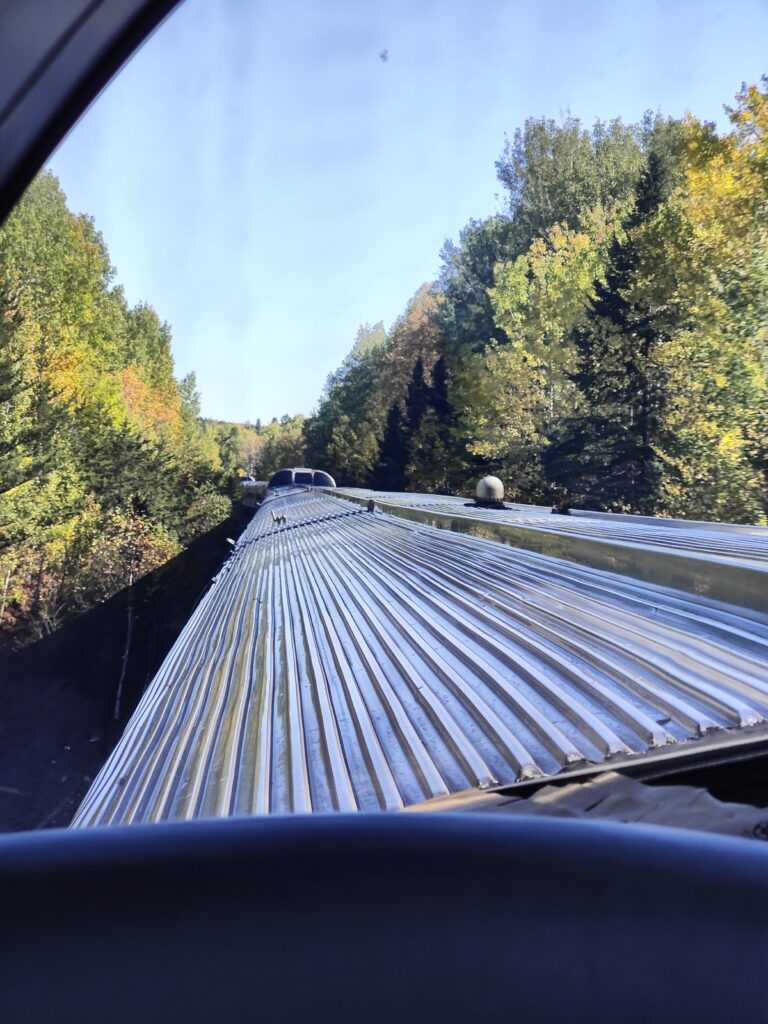
Looking back out the dome to the rear of the train
Just capturing something notable from the Caporel stop mentioned last time. They opened the whole train for this one, because the siding at the station was long enough. So the people from the more Lux cars stepped out too. Not enough to mingle, but enough to see that they were there.
Kind of a reverse Snowpiercer (2013) thing happening: the nicer cars are further from the engine, due to Noise and the like, and fewer disturbances with people walking through.
Given the cost for those lux fares, this is effectively separation by class as well.
In 2025, it might be impossible to make a post about train travel without referencing Snowpiercer, Bong Joon Ho’s creative filmic adaptation of the french graphic novel Le Transperceneige, in much the same way that earlier posts would have talked about Murder on the Orient Express or some other cultural referent. (Did we ever get “Speed but on a train” as the high concept for a film in the mid 90s? I know that series stopped with the boat).
Point being, there might be something endemic about trains, especially the passenger variety, and how they’ve been serving customers for travel for the past two-hundred and twenty some-odd years.
(Is that all? It seems like such a dominant form of travel for the modern era, since eclipsed by passenger flight in the second half of the twentieth century. The speed at which the railways grew must have been mind boggling to those who witnessed it.)
Those early passenger trains, built in Britain and serving the particular nature of that class system of the Victorian era, echoes through time to how they’re experienced now (still), and how we feel ourselves experiencing the rails, mediated through the images and movies we’ve seen before we even step foot on the stairs into the car.
The built environment is not just the buildings around us, but the ways we move as well.
There will be some spoilers in this review and commentary about the recent film.
Do you ever go to a theatre and see a movie with incredible potential but it doesn’t quite reach it, it doesn’t take that next step to get where it needs to be to reach that level of greatness?
Mickey 17 (2025) movie poster
That was my experience with Mickey 17 (2025), a movie I enjoyed, with a great concept and cast, and had so many things go for it, but it felt like it was holding back, and this made it a “smaller” film than it could have been, if it really wanted to take some of the ideas that it was exploring up to the next level.
The political commentary in the film was on the nose, which is remarkable given how long ago this would have likely been in pre-production* and development to nail that, but it seems almost restrained compared to current events that we’re dealing with right now (in April of 2025).
We also see continuing elements of class and social commentary that Bong Joon Ho has had in his other films like Parasite (2019) and Snowpiercer (2013), and there’s a lot of similarities with Snowpiercer in this film. They’re both deeply chilling movie in the same way, and this only is in part due to the winter environment that’s an existential threat that forces humanity in on itself. Hmmm. Probably a paper there needed to unpack all that.
However, the part where the movie hit a wall for me is with the implications of the 3D printing tech and the memory storage: it didn’t take it far enough and explore what it could actually do – it took it to a certain point and just stopped, which is unfortunate, as other movies with similar themes like Edge of Tomorrow (2014) or Westworld (1973) and Futureworld (1976) (or the 2016 HBO series) where we have that printing technology going on explored it better, and I think that speaks to some of the films limitations.
One of the ways Mickey 17 falls short is in the portrayal of the 3D-printing technology and the way it is integrated within society. The tech itself comes across as both silly and kinda dorky in the way it’s implemented, with the slow emergence like from a dot matrix printer in the 1990s to the fully-completed form. This is where Leeloo’s build in The Fifth Element (1997) or the hosts emerging from the vat in Westworld (2016) feel more fully realized. The silliness of the process works, in so far that it also highlight the somewhat bizarre way that this future society treats the implications of this tech. So many questions remain poorly answered by the film: why only one person per ship as an Expendable? Why not multiples for each role on the ship (or at least for the combat, exploration, and scout crews?) Why limit what is essentially nigh-immortality to a very limited underclass? Why would the ultra-wealthy not jump on this very tech? (Though this last point is kinda hinted at in the dream sequence in the epilogue). This silliness brings Mickey 17 more in line with other films like Prometheus (2012), and to be honest, I’ve never really enjoyed movies that kick around the idiot ball.
Some of this is answered, though not to my satisfaction, in the presentation of the Expendables and Multiples in the film. The religious proscription against having more than one, and the way they are treated. And of course, the use of the gun as the final commitment to the process (similar to dog in Kingsman (2015)) may be a bridge too far, though one that the crews of Starfleet have long since overcome. (The argument about whether the transporter kills the user or not having gone on for ages.) If one is already on the upper tier of society, would one be willing to risk it all to achieve this pseudo-immortality?
It might be too much to give up, as the process isn’t exactly perfect. We learn in the second act that there are variations in various duplicates, as they emerge from the printer. Whether this is due to the somewhat less that rigorous process of printing and downloading that occurs by the medical team – who remind one of a collection of grad students in a lab, rather than the most top-notch team out there – or due to some natural variations in the printing process is unexplained. There is a lot of difference in the repetition, and this variance might not be appealing to the ultra-wealthy that would be demanding a greater degree to fidelity in the transfers, much as was seen in the aforementioned Westworld in its later seasons.
Ultimately Mickey 17 is a love story. Despite the difference in each iteration of the various Mickeys, each one of them is loved by Nasha, who he loves in turn. Their meet cute happens early in the movie, and it’s love at first site, a love that endures through each reprinting of Mickey. His love for her is constant (and she does change and grow through the movie too – the role she plays at the end of the film is not who we see at the beginning – as is her love for him, throughout all the different foibles and flaws of the many personalities that are printed.
Though there some throughlines, some continuity in the bedrock personality, which is why Mickey 18 makes the sacrifice play late in the film, despite the wildly different personality from 17. Props to Robert Pattinson for pulling off making the same character feel different in Mickey’s varied iterations.
Final thoughts: Mickey 17 is well crafted, there isn’t any misses in the production aspects of it, though some of the satire misses due to the low-key nature of it. I want to see the Luc Besson version of Mickey 17, that takes the premise and goes all out.
*: apparently this is an adaptation**, which I had heard about going in but hadn’t checked the book out. Also, the book was published in 2022, and adapted shortly after, and was originally delayed in release from it’s original set date in 2024. So the political stuff is even more poignant, or perhaps sadly, more eternal.
**: also, in looking at the wiki after writing the above, the short story was also an exploration of the Star Trek teleporter paradox, so… hmm, yeah.