Takes on a Train 5 – Snowpiercer

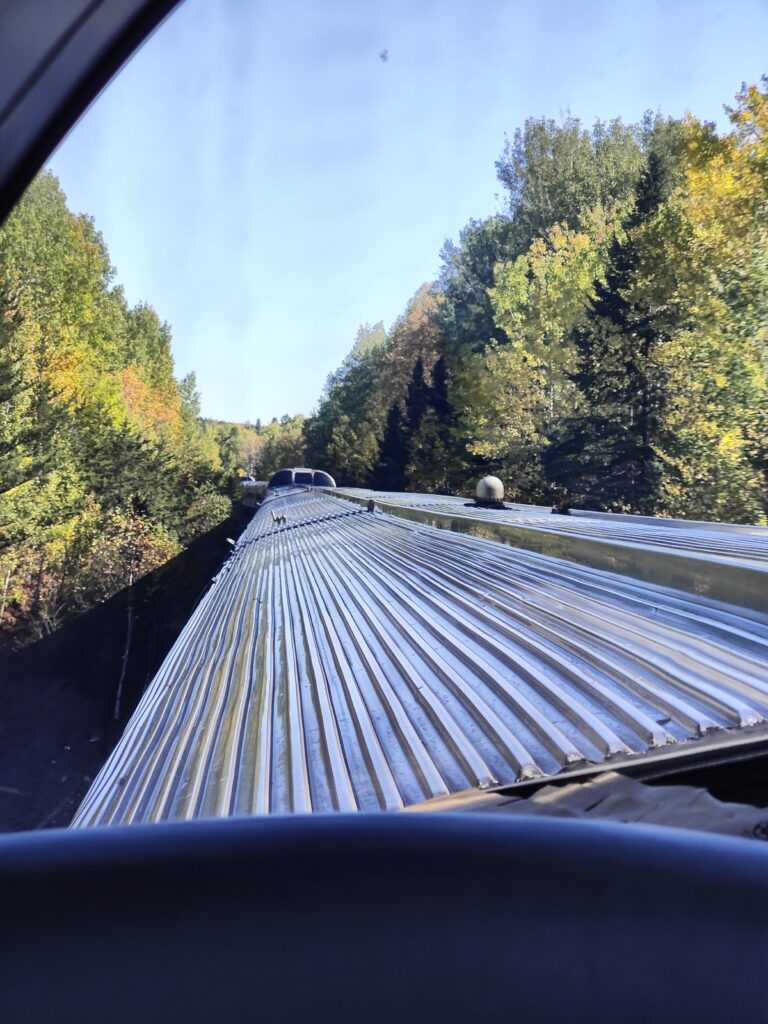
Looking back out the dome to the rear of the train

Just capturing something notable from the Caporel stop mentioned last time. They opened the whole train for this one, because the siding at the station was long enough. So the people from the more Lux cars stepped out too. Not enough to mingle, but enough to see that they were there.

Kind of a reverse Snowpiercer (2013) thing happening: the nicer cars are further from the engine, due to Noise and the like, and fewer disturbances with people walking through.

Given the cost for those lux fares, this is effectively separation by class as well.


In 2025, it might be impossible to make a post about train travel without referencing Snowpiercer, Bong Joon Ho’s creative filmic adaptation of the french graphic novel Le Transperceneige, in much the same way that earlier posts would have talked about Murder on the Orient Express or some other cultural referent. (Did we ever get “Speed but on a train” as the high concept for a film in the mid 90s? I know that series stopped with the boat).

Point being, there might be something endemic about trains, especially the passenger variety, and how they’ve been serving customers for travel for the past two-hundred and twenty some-odd years.

(Is that all? It seems like such a dominant form of travel for the modern era, since eclipsed by passenger flight in the second half of the twentieth century. The speed at which the railways grew must have been mind boggling to those who witnessed it.)

Those early passenger trains, built in Britain and serving the particular nature of that class system of the Victorian era, echoes through time to how they’re experienced now (still), and how we feel ourselves experiencing the rails, mediated through the images and movies we’ve seen before we even step foot on the stairs into the car.

The built environment is not just the buildings around us, but the ways we move as well.

Media Health, part 1: turn off the firehose

The last few weeks of January 2025 has seen a torrent of news stories coming down the pipeline, and it can be daunting and exhausting, and deeply healthy. Perhaps we need to think of this in terms of our media health, in the same way that we have physical health and mental health. We’ll make this distinction from things like media literacy, which is talking about something different, though still related, and focus on practical steps that can help maintain a healthy interaction with the media.

And, as indicated by the “part 1” in the title, this will be a series. It’s one that likely should have been shared more widely over the last few years, but while the best time to start was 10 years ago, the next best time is now.

Let’s get started with a summary of some steps for dealing with the flood:


Turn the firehose off. The flood of information is done by design, to overwhelm you, to give a sense of inevitability and omnipresence. Stay vigilant, but don’t doomscroll.

Don’t check the news first thing in the morning. Check a trusted source of information at an appropriate time: end of the workday or after supper. Not right before bed (bad for sleep) or first thing in the morning (uses up all your spoons early, and you’re back to scrolling or wiped out).

If there are “news” feeds or influencers that trade in rage bait for views, delete or block, and if you find you’re more on edge after seeing a particular creator, block or mute too. This might include “friendly” sources of info. Find a digest or summary version rather than a firehose. I can’t stress this enough. Within the attention economy, stuff that looks like it’s on your side can still be utilizing tactics that are not in your best interest.

The one place you (may) want to make an exception is for local news sources, as this will have a more significant impact than the national flood. Stick with a trusted local source, that doesn’t fold in all the national stuff, and keep your ear to the ground for the stuff that affects you.


Alright, now that the firehose is off, how do you start dealing with the accumulated flood? I think we’ll need to deal with that in part 2.