Implausipod EP008: Audience Commodity

(Editor’s note: this is part 2 of the previous post on the audience commodity, which was drawn from a discussion thread on Mastodon. Much of that made it into the transcript of both the Youtube episode and the Podcast (both embedded below). This post will include the full transcript of the audio (and video), so there may be some duplication with the previous post, in the interest of completeness.

If this format of posting works out, then they should be better aligned in the future. Still working on the basics of the POSSE system. Better life through Additive Manufacturing though; iterate and improve. In the meantime, enjoy!)

The link to audio version, from Implausipod Episode 008 is here: https://www.implausipod.com/1935232/13185814-implausipod-e0008-audience-commodity


Introduction

Getting started with a brief rundown of an old article that details the rise of the Audience Commodity: Smythe (1977) “Communications: Blindspot of Western Marxism”, we use that to explain the recent events of the internet of the last month or so, including the Twitter-pocalypse, the Reddit Meltdown, the rise of ChatGPT, and some general media theory too.


Transcript

 Welcome to the Implausipod, a podcast about the intersection of art, technology, and popular culture. I’m your host, Dr. Implausible, and as we return to a regular recording schedule, I’m going to introduce you to the audience commodity, an old idea from economics tat goes a long way to explain some of the current events we’re seeing in the social media spaces.

What exactly is the audience commodity? Well, that’s a fantastic question. With the recent introduction of Threads a little bit ahead of schedule because of the Twitter apocalypse, I thought it’d be worth going into the background of it because it’s really got some relevance for the current events that are happening today. Because it was published in a relatively obscure Canadian academic journal back in the seventies, it hasn’t seen that much adoption by mainstream economics, but we’ll get into it. If that the kind of thing is your bag, then by all means, stick around.

In short, the audience commodity is all about how you and I and all of us really are turned into products by the cultural industries, whether it’s media or advertisements or websites.

I’ll put the citation on the screen (see below) for those that are interested. The author, Dallas W. Smythe was writing it as a bit of a challenge to traditional Marxist economic thinking at the time in the seventies. He said they were getting it wrong when it came to the cultural industries and the impact that they actually had, what they were doing.

Now Dallas Smythe was a former economist at the FCC, and he was blacklisted due to McCarthyism. I mean, Hoover had a file on him, for reasons, and he is drawing heavily on a book called Monopoly Capital that was put out in the sixties by Baran and Sweezy. We should probably do a whole episode on that at some point in time, but we’ll see how this goes.

Now for Smythe, the main argument speaks directly to Facebook or Meta’s business model. This goes the same for like Google and everything else too. And what is their business model? Websites? No. Apps? No. Advertising? Close, but still not the whole picture. Their business model is the production of the audience commodity. Advertisers buy audiences and those audiences. Time is their labor. And how did Smythe come to this conclusion? Well, he’s asking a simple economic question. Basically, what economic functions for capital do mass communication systems serve? And in this case, both Google and Facebook, Meta and Alphabet, whatever, both fit in the same “mass” of mass communication. They have a huge reach. So in order to figure out the economic function, you need to figure out what the commodity those companies produce actually is. And you might think you know what this is, it’s the whole: “if you’re not paying, you’re the product” line. And this is a part of that, only in a lot more detail.

A part of Smythe’s argument is that traditional economics was getting it wrong. If you asked “what does the media produce?”, you might answer something like content or information or messages or entertainment or shows or something like that. And that’s understandable. It’s what it looks like they do. So you’d be forgiven if you thought That’s how it worked, because that was the traditional orthodox idealist point of view.  It was held by everybody from Marx to Galbraith to Veblen to McCluhan. There’s a lot of academic writing on this idea and non-academic writing too. Everybody thought that’s what was going on. Smythe’s argument is that it misses the point. If the trad orthodox view of economics is getting it wrong, what do the media companies actually produce?

What is the commodity form of advertising sponsored communications under “late capitalism”, or “monopoly capitalism” as Baran and Sweezy would say? The answer is audiences and readerships, or just the audience. The audience commodity here, the labor power of the workers, is resold to the advertisers. This is normally in the parlance of the time called the Consciousness industry.

So remember this: TV stations and walled platforms on the internet are factories that produce audiences for advertisers. That’s what’s coming outta the end of the factory. So that’s a lot of the overarching stuff. Let’s get into some of the specifics. Smythe has eight main points, and we’re gonna cover these quickly and then move on to how it connects to the social media platforms: Threads, Facebook, Twitter, TikTok, AOL, Reddit, whatever.  

So Smythe’s questions are in order. Here we go. Question one, what did the advertisers buy with their money? Answer: the services of audiences in predictable numbers. It’s a service economy and we are the ones providing the service.  We’re also ones being a served up, which is, I guess, ironic. The commodity is the collective.

Question two, how do advertisers know what they’re getting what they’re paid for? Well, various rating agencies back in the day, like the Nielsen’s and whatever, and the analysis, which has largely moved in-house for streaming and internet platforms.  There’s a whole host of stuff that falls under the umbrella of market research.

Question three, what institutions produce the commodity that advertisers want? Well, we’ve hinted at this, but it’s principally and traditionally the owners of TV and radio stations and newspapers and magazine publishers, and we can add most web platforms to this nowadays ’cause they all work on the same model.  Of course there’s a host of secondary producers in industries that provide content for the principal market, obviously, but this is the main outlet.

Question four, and what is the nature of that content in economic terms under monopoly capitalism or late capitalism? Well, it’s an inducement. It’s the free lunch that attracts the audience to the saloon.  It gets ’em in the door and encourages them to stay. Now this speaks nothing to the cost, the quality, the format. In fact, the cheaper that this can be procured, the better. A free lunch isn’t free, obviously, but someone is providing the bread and the meat, and if the users bring their own, it’s the case of social media then even better.  And what are those users doing?

Question five, what is the nature of the servers performed for the advertiser by members of the purchased audiences? Well, the audience commodity is in economic terms, a non-durable producer’s good bought and used in the marketing of the advertiser’s product. The work that the audience is doing is to learn to buy and consume various brands of products and spend their income accordingly.

If they can develop brand loyalty while doing this, then that’s fantastic. Now, there’s a whole lot of work that goes into that learning. It’s like the reproduction of ideology and Ian terms and a whole lot more going on. But we will again, delve into this and either later in this episode or in future episodes as we keep this going on, but for Smythe, question five is all about the management of demand.

And question six is the big one: How does the management of that demand relate to the notion of free or leisure time under the labor theory of value? And for Smythe the answer is: the goal under monopoly capitalism is for all non-sleeping time to be work time for most of the population. I’ll let you do the math on the missing percentage yourself, but basically free time and leisure time are all turned into work time and in the 21st century, even work time can do double duty as branded elements take place within work.

Now Smythe goes on for about four pages in answering number six. It’s this key point and there’s a lot to unpack there. So again, we’re gonna circle back, but in the interest of brevity:

question seven, does the audience commodity perform an essential economic function? Well, the answer there is “it’s complicated”.  As noted above, Orthodox theories didn’t really go into this, and mass media and brands were before Marx’s time, so he didn’t have much to say about them either. Smythe turns to Marx’s Grundrisse to tease out an answer where production produces consumption, which is, I think page 91 and 92. There’s a whole paragraph on it.  So yes, there’s an essential economic function that’s taking place, but again, it isn’t what we think it is.

Question eight addresses some of that, what we touched on earlier, which is why have the traditional Marxist economists been indifferent to the role of advertising? They were focused on content instead.  Again, this is in the seventies, and it was obviously shiny things. The content was front and center, so people thought that that was what was going on. Remember, this is 1977, a full decade before authors Edward Herman and Noam Chomsky were publishing “Manufacturing Consent”, even though this was contemporaneous with some of Edward Herman’s earlier writings.

Now Smythe had actually published two versions of this paper. The peer reviewed article from 1977 that we’ve been using, and again, it came up as a chapter in 1981’s Dependency Road. These are again, foundational, critical for understanding what’s going on, but what does it mean for right now? Now as I’m recording this, on the evening of July 6th, 2023, Facebook has just launched Threads their Twitter competitor within the last 24 hours.

Earlier this week when I was writing it, I thought the main argument would be the Reddit implosion and Twitter’s issues, which were leading to a mass exodus of users looking for an alternative and heading towards the Fediverse, including Mastodon, which is an ActivityPub protocol tool that’s very similar in some ways to early Twitter.

Earlier, back in June or a thousand years ago, it seems, there was a lot of discussion on the Fediverse because there was news that Facebook was using the ActivityPub protocol for their Threads tools. All of this has gone by in like, you know, Lightspeed, where weeks, sometimes decades happen, right.

Anyways, when I started drafting this in response to those particular events and the general bad idea of engaging with Facebook on anything, (we’ll get into what Triple E means, probably in a future episode too), the online universe was vastly different. The Reddit moderator strike wasn’t even a thing that had happened yet, and even though there was problems at Twitter, it didn’t seem to be the mass expulsion that happened on July 1st.

So let’s tie it back to our main characters. Both Meta and Alphabet, Facebook and Google are well entrenched as advertising companies at this point. There’s no surprises going on there, and it’s also, it’s reasonably well known what’s going on when the auction service is used, being detailed in this explainer from the markup (see below).  I’ll put the link up in the show notes here. I.

They also have a wonderful explainer article going into the breakdown of market segmentation that’s done by, in this case, Microsoft and their Xandr platform, but actually takes place behind the scenes by all of these major social media companies. And these major companies know exactly what they’re doing, or they get into troubles when they lose sight of exactly what their core business model is serving up an audience to their customers, the advertisers.

Often they get themselves distracted by thinking themselves of content providers, and really that’s not the case. The most famous example of this would be like AOL. When they bought Time Warner and moved into providing content on a more regular basis, they kind of lost track of what they’re doing. Their subsequent failure and being overtaken by like everything else on the internet really speaks to them losing sight of that fact and investing in areas where they shouldn’t have. If AOL had focused on either infrastructure or their core business model, the audience, they would’ve weathered the dot-com bust significantly better than all the other companies out there.

But they got distracted by the shininess of Hollywood and thought that they were in the content business. So too, for Reddit and Twitter is some of the problems that they’ve had or because of moves that they’ve made to protect that content. But they can be forgiven slightly because there’s something that changed, something that Smythe didn’t foresee back in 1977.

And that’s AI. See AI flipped the equation around a little bit and turned all that user generated content stuff provided by the labor of the audience for free into something useful data for their large language models. You can understand why Elon Musk and Steve Huffman are a little bit miffed. Imagine you had a lumber mill and someone came in and took a look around and said, “Hey, you’re doing anything with all that sawdust?” and he said “No, take it”. And then they took that useless byproduct and added a little bit of glue to it, and all of a sudden turned it into, I don’t know, designer Swedish furniture and made a mint. You’d be like, what’s going on here? And try and stop them from taking the sawdust and figure out how to use it yourself, because all of a sudden, that stuff’s gold.

Jerry Gold. Because they didn’t know it or didn’t understand the process, both read it and Twitter in the process of lighting a fire in their factory and burning it to the ground. And meanwhile, the users, the audience commodity that was driving their business are all exiting stage left. And that pretty much gets us up to now.

Now we haven’t even gone into some of the other events like TikTok and the proposed ban that seems to be continually ongoing or some of the other social media networks or television, broadcast tv, what’s happening over there. And we also haven’t really gone into Threads and their use of the ActivityPub protocol that we kind of hinted at it.

But we need to get into something else related to that. And that’s a philosophy called Triple E or Embrace Extend Extinguish, but I think that’s gonna be a whole other video. Things are moving pretty fast and I’m just one guy. So for now, we’ll just wrap this up and try and catch the next one. I’m Dr. Implausible. The audio will be available over on the Implausible Pod and the text of the show should be available on the blog or in the comments sometime soon. The whole show is produced under the Creative Comments Attribution Sharealike 4.0 International Public License. We’ll try and make this one look prettier as I figure out how this whole video thing works.

But in the meantime, the world’s moving pretty fast, so we’ll see what it looks like in a week or so. I’m Dr. Implausible. Have fun.


Other links and references:

Baran, P. A., & Sweezy, P. M. (1966). Monopoly Capital. Monthly Review Press.

Smythe, D. W. (1981). Dependency Road: Communications, Capitalism, Consciousness, and Canada (Revised ed. edition). Praeger.

Eastwood, J., Hongsdusit, G., & Keegan, J. (2023, June 23). How Your Attention Is Auctioned Off to Advertisers – The Markup. https://themarkup.org/privacy/2023/06/23/how-your-attention-is-auctioned-off-to-advertisers

Keegan, J., & Eastwood, J. (2023, June 8). From “Heavy Purchasers” of Pregnancy Tests to the Depression-Prone: We Found 650,000 Ways Advertisers Label You – The Markup. https://themarkup.org/privacy/2023/06/08/from-heavy-purchasers-of-pregnancy-tests-to-the-depression-prone-we-found-650000-ways-advertisers-label-you


The Audience Commodity, an overview

From posts made to Mastodon account as of 2023-07-04
https://mastodon.online/@drimplausible

With looming introduction of Threads and the subsequent integration with the fediverse I thought a quick summary of a key piece of economics literature is in order. Likely too late, but perhaps not.

Basically, what is the Facebook or Meta business model?

The production of the audience commodity

(This is from 1977, by Dallas W. Smythe, so some of it may seem obvious in retrospect. Please read it through. Also I’m posting as I go, so it might take a bit).

So what is the question Smythe is trying to answer when it comes to the audience commodity? Basically, “what economic functions for capital do mass communications systems serve?” (And Google and Facebook both fit in with the “mass” in mass communications here).

In order to figure out this function, you need to figure out what the commodity they produce actually is. You might think you know the whole “if you’re not paying, you’re the product” line. This is part of that.

Now if you’re asked “what does media produce” you might answer something like content or information or messages or entertainment.

This is understandable. This is what it looks like they do. You’re forgiven if you thought that’s how it worked. This is the trad, orthodox, “idealist” POV. This is held by everyone from Galbraith to Marx to Veblen to McLuhan

So there’s a lot of press on this idea. Smythe’s argument is that it misses the point.

4/ So if the trad, orthodox, normal economics view of mass communication gets it wrong, what do they produce? What is the commodity form of advertising sponsored (mass)communications under late capitalism ?

Audiences and readerships.

The audience commodity.

Here the work, the labour power of the workers is resold to the advertisers. This is nominally the “consciousness industry”.

Remember: TV stations and walled platforms on the internet are factories that produce audiences for advertisers

So that’s a lot of the overarching stuff. let’s get into the specifics. Smythe has 8 main points. We’ll cover these quickly then move on to how it connects to Facebook and the fediverse

Q1) What do the advertisers buy with their money?
A) The services of audiences in predictable numbers.

It’s a service economy and we’re the ones providing the service.

(We’re also the ones being served up. Ironic!)

The commodity is the collective.

Q2) How do advertisers know they’re getting what they paid for?
A) Various ratings agencies, bitd, and the analysis which has largely moved in-house for streaming and internet platforms. This would be the Nielsen’s and a whole host of stuff under the umbrella of “market research”.

Q3): What institutions produce the commodity that advertisers want?
A) Principally, and traditionally, it’s the owners of TV and radio stations, and newspaper and magazine publishers. You can add most web platforms to this nowadays. Of course, there’s a host of secondary producers, and industries that provide content for the principal market, obviously, but this is the main outlet.

Q4) what is the nature of content in economic terms under late capitalism ?
A) it’s an inducement. It’s the “free lunch” that attracts the audience in the door, and encourages them to stay.

This speaks nothing to cost, “quality”, or format. In fact, the cheaper this can be procured, the better. A free lunch isn’t free, obvs, but someone is providing the bread and meat.

If the users bring their own, even better.

Q5): “What is the nature of the service performed for the advertiser by members of the purchased audiences?
A): The audience commodity is “a non-durable producer’s good bought and used in the marketing of the advertiser’s product”. The work the audience does is to learn to buy and consume various brands of products, and spend their income accordingly. If they can develop brand loyalty while doing this, even better

(Almost done, honest.)

Q6) How does the management of demand relate to the notion of “free” or “leisure” time under the labour theory of value?
A) The goal under monopoly capitalism is for all non-sleeping time to be work time. (For most of the population. I’ll let you do the math on the missing percentage yourself). Free time and leisure time are turned into work time. (And in the 21st century even work time can do double duty.)

(Note: Smythe goes on for 4 pages in Q6, above. It’s his key point and there’s a lot to unpack.)

Q7): Does the audience commodity perform an essential #economic function?
A) it’s complicated. As noted above, orthodox theories didn’t really go into this, and mass media and brands were before Marx ‘s time, so he didn’t say much about them either.

Smythe turns to the Grundrisse to tease out an answer: “production produces consumption” (p.91-2; that whole paragraph).

So, yes: essential.

Q8) Why have Marxist economists been indifferent to the role of advertising and focused on content instead?
A) Shiny things, obviously. Remember, this is being published in 1977, a decade before authors like Noam Chomsky would publish Manufacturing Consent.

Smythe published two versions of this, the peer-reviewed article I’ve been using, and again in 1981 in Dependency Road. Again, foundational. Critical for understanding what’s going on.

What does it mean for right now?

So just to link the above thread with some current events in social media:

Both Meta and Alphabet are well entrenched as advertising companies at this point. No surprises.

Also, it’s reasonably well known what’s going on, with the auction service being detailed in this explainer from @themarkup :
https://themarkup.org/privacy/2023/06/23/how-your-attention-is-auctioned-off-to-advertisers

And follow the link in their article to the breakdown of market segmentation by Microsoft in their Xandr platform.


(Part 2 coming tomorrow!)

Foundational Books

What are the books that shape you?
…that influence your beliefs>
…that change your mind?
…that transform you into the person you are today?

I was looking for something on the bookshelf the other day and came across a book that I hadn’t looked at in quite some time (Saul’s The Doubter’s Companion, fwiw), and saw the notes and underlining, clearly made with intent, by some other me decades ago.

So I dug deeper into the bookshelf, and came up with a list:

  • John Ralston Saul, The Doubter’s Companion
  • John Ralston Saul, On Equilibrium
  • Daniel Dennett, Darwin’s Dangerous Idea
  • Mihalyi Csikzentmihalyi, Creativity
  • G.M. Peter Swann, Common Innovation
  • Douglass Rushkoff, Program or be Programmed
  • Neil Postman, Amusing Ourselves to Death
  • Raymond Williams, On Television
  • Langdon Winner, The Whale and the Reactor
  • Dierdre McCloskey, The Rhetoric of Economics
  • Richard Lanham, Economics of Attention
  • Marshall McLuhan, Understanding Media
  • Walter Ong, Orality and Literacy
  • Eric Havelock, Origins of Western Literacy
  • Richard Rorty, Contingency, Irony, Solidarity
  • Norbert Weiner, Cybernetics
  • Katie Hafner and Matthew Lyon, Where Wizards Stay Up Late
  • Peter Berger and Thomas Luckmann, The Social Construction of Reality
  • Brian Kernighan and Rob Pike, The Practice of Programming

Now, a few words. This is a foundational list. But there are several things that it’s not, so we’ll define it by that. It’s not a top ten, and it’s not in any order, save for as they came to mind. (This may reveal the associations and linkages in my mind, but no more). And looking at it, it is necessarily incomplete; it’s a start.

They may not be the most notable or celebrated work by some of these authors (though in some cases they are), but they are the ones I bought, read, experienced, and retained, and through all of them I can find echoes of my current beliefs, attitudes and outlooks, so in echo of Borges’ Quixote, I’ll note them down so the path can be retraced.

I think a book a week is a good pace for a re-read. Let’s dive into the foundations of the bookshelf…

Grimdark, Tone, (and Disney)

What’s happening to the Star Wars universe? I mean, yes, there are problems, and some of these are coming to the forefront, where the demand for increased throughput of the EFP (ie “content”) through the pipes of consumption exposes any flaws or imperfections in the infrastructure, and… to absolutely bury the metaphor… eventually the system buckles under the pressure and cracks…

Spewing stuff everywhere in full Technicolor with Dolby sound… ?

Anyhoo, this is an article on tone, mostly. Shades of grey and brown, apparently. Disney isn’t using the full color palette is what I’m getting at. But we’re starting at the end of the discussion, with burst pipes and a flooded basement. How did we get here?

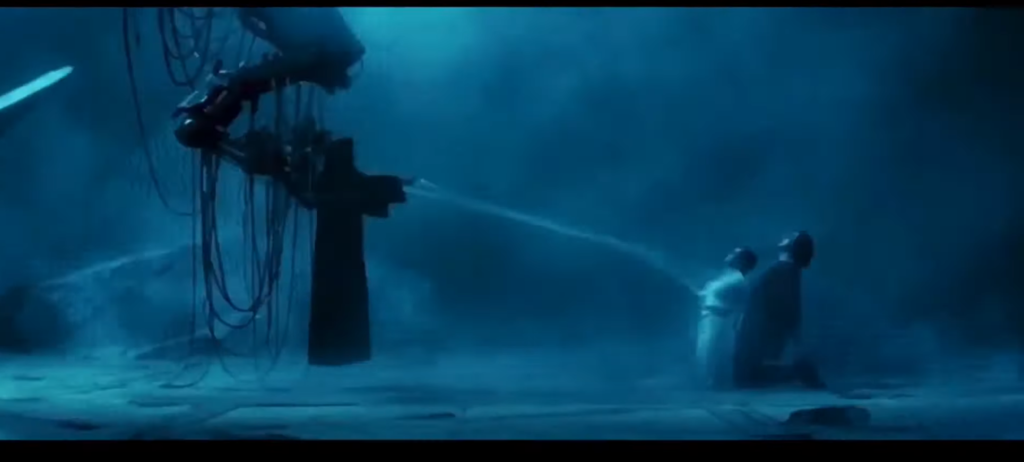
It started with a re-watch of SW9:RotS on the streams a little while back. I was half interested, and hardly paying attention when the scene in the Emperor’s rejuvenation chamber came up… and it struck me.

The Grimdark.

The biomechanical rejuvenation chambers, the archaeotech, the fractured remains, the body horror.

These are not elements of a Star Wars movie.

They come from… elsewhere.

And I think this speaks to the recent disconnect [between the fans and the franchise].

As we’ve argued elsewhere on the Grimdark* , it is an essential feature of the Warhammer 40K universe.

(*check out podcast episode #… Whoops. Did I post that? One moment…)

And as we’ve argued at the outset of the Appendix W series, W40K was a hodge-podge of every science fiction trope from the 60s, 70s, and 80s, put in a blender, and with the mix pushed through the speakers turned up to 11. And early Star Wars (the original trilogy, plus some of the EU stuff available at the time, like the ongoing Marvel comic series and early novelizations) was definitely thrown in the blender like everything else.

Vader as an armored force-using, laser sword wielding transhuman cyborg super-soldier definitely counts as a proto-40K influence.

Of course, in the grim darkness of the 41st millennium, there’s a couple thousand like him working for the Imperium of man alone. In W40K, the dial that goes up to 11 increases exponentially. Darth Vader would be in for a very tough fight.

The other big influence that makes the Grimdark grim and/or dark is that fallen sense of technology. The “dying earth” subgenre of sci-fi, where the 20th century may be a distant memory. Often indistinguishable from fantasy, and drawing mostly from a couple strong influences like well, Vance’s Dying Earth and the Wolfe’s Shadow of the Torturer series**. And Herbert’s Dune, after a fashion. All of these are in the grimdark blender too.

** Did we post that up in the Appendix W either? No? Well then, shortly.

And while there is a pretty direct line between Dune and SW4:ANH, the grim dark filter hadn’t been built yet. So the appearance of the Grimdark in the SW universe in 2019 signified a rather significant shift in tone. And it’s appeared in the Mando-verse as well over on Disney+, notably in Season 3, with the Armorer and the mass jet pack fight.

Much like the emperor’s rejuvenation chamber in SW9:RotS, the overlap of the grimdark becomes readily apparent in Mando S3. Part of this is just the material there’s only so many ways to portray a massed group of faceless space knights, and the shift in focal point characters in SW from “space monk with laser sword” to “power armor space knight” will by necessity lead in certain ways. There’s just certain kinds of stories you can tell in that framework, and GW has managed to deliver an exterminatus to the concept with over 100 novels(?) in the 40K universe.

But I digress: when we see the jetpack assault by the massed Mandalorian army in S3E8, there has been no better cinematic visualization of an Adeptus Astartes assault company incursion. And Paz’s stand with the minigun (with it’s echoes of both Jesse “the Body” Ventura’s Blain in Predator (1987) and Jiang Wen’s Baze Malbus in the aforementioned Rogue One (2016)) could substitute for 35 years of a Terminator Astartes armed with an Assault Cannon facing off against innumerable foes. And that last image provides us a rather helpful clue.

It’s difficult to pinpoint the exact moment of inception, when the SW universe made the Grimdark turn. While there are elements of it throughout the sequel trilogy, Rogue One (2016) feels like a reasonable candidate. It too marked a dramatic shift in visuals and tone, standing apart from the “mainline” Star Wars films the way that it does, and with the generally positive fan and critical reception it enjoyed as well. Rogue One was still recognizably Star Wars, though darker in tone and “more mature”, appealing to an older audience that had fond memories of the original (and perhaps even the prequel) trilogies, and appreciated the mature take. In a post-AGoT era for genre on the big screen, the expectations of a more mature audience were met by Rogue One‘s screen presence.

But this more mature audience isn’t necessarily the audience that the sequel trilogy was needing to court. Star Wars seems to be pointed at a mainline audience of “the eternal 12 year old”***, an archetypical audience that is seduced by tales of the hero’s journey and see themselves within it, as long as they have the merch to go with. And Disney loves getting new fans for their franchises.

***: I could be wrong; they could be as young as eight.

And this is where the tone comes back into the picture. Because the Grimdark is defined as a universe where everything sucks and there are no good guys. Star Wars is more famously a universe with a New Hope.

This doesn’t mean there isn’t room for darker tales within the Star Wars universe; there most definitely is. The challenge comes in crossing the streams, mixing the Duff with the Duff Dark and Duff Light. Bringing the grimdark aesthetic over from a one-off that was successful for a host of reasons (of which the aesthetic was only a small part) into the mainline film series risks turning off the fans that the mainline audience are geared toward, the ETYO that Disney craves. Star Wars is an umbrella brand, and not all components that contribute to the franchise need to be geared to every part. They recognize this with the merch (I’m sure there is some overlap between Grogu squishmallows, SW Lego builders, and Mando cosplayers, but y’know, different strokes rule the world).

So is this a problem? No, not really, not in the sense that we’re contributing to the “Problemitization of Everything”. And perhaps not in the sense of it’s connection to other ongoing issues. Just an observation, drawn from the images on screen, and the connections and linkages that exist. It’s part of a trend, perhaps, one that fits with some other things that are going on.

The shift in tone, may be a larger problem, long-term, for a multi-billion dollar corporation that is struggling with producing sustainable results while keeping the franchise afloat. But that’s a them problem, and possibly unrelated to this shift in tone.

But it might be, too. I feel like this bears looking out for over the coming years.


Credits:

  • Star Wars images copyright Disney 2019, 2023
  • Warhammer 40K images copyright Games Workshop 2023

Where is the line? AKA “Cuddlefication of Brutality”

Where is the line…
… when the joke stops being funny?
… between cosplay and copaganda?
… between parody and promotion?
… between representation and reinforcement?
… where the successive waves of Disneyization of the Star Wars universe have blurred the lines so much that we forgot what the original represents.
That those are indeed “the baddies”.
Because if we look at the subtext here, or perhaps even the literal text, it isn’t that subtle.

Then what we have here is objectively terrible:

A foot soldier of an authoritarian and fascist empire uses a war trophy taken as spoils following the extermination of a minority population and celebrates with the unboxing of a new weapon of war.

Did the above capture the essence of it?

Ah, it’s funny, it’s goofy, it’s relatable.
And through this cuddlefication of brutality*, the line continues to blur.

When we look back, can we tell when the line has been crossed? Or is that only something we can tell in retrospect, with the benefit of hindsight?
(Do we know we’ve reached the Rubicon, or are we informed after the fact?)

Where we can say this, this is the point where we became accommodating, where we become comfortable with fascism, with the fun-loving stormtroopers and their goofy antics, where the clear delineations of the original films become blurred and muddied, cuddly and coddled.

So if this is the line, when do we step back? Can we back away? Are we already too late?

(*Perhaps I’m being dramatic? Maybe, but I don’t think so.)


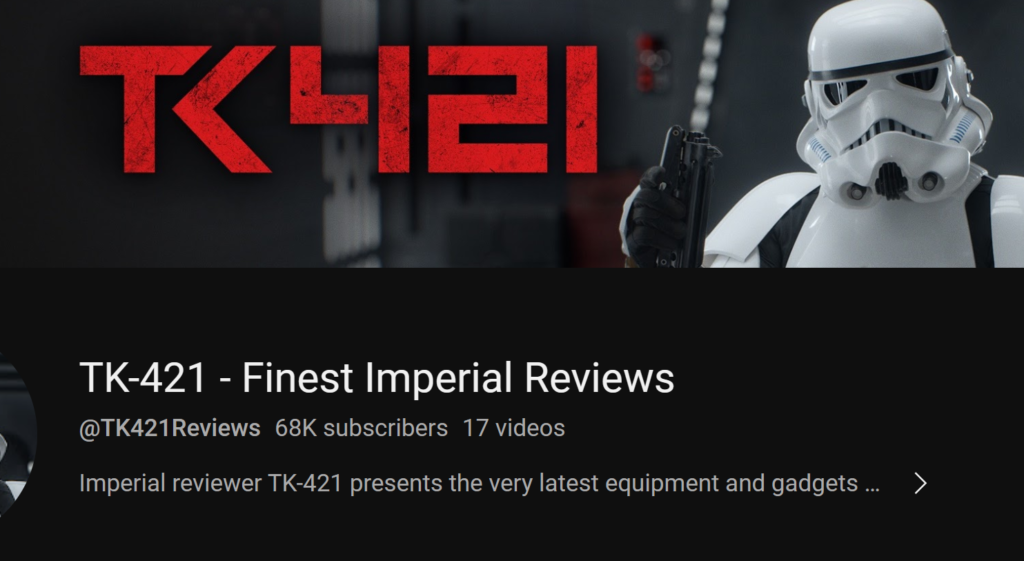
The genesis for this was a cutesy stormtrooper “unboxing” video that circulated on social media, most notably the ‘Tube and the ‘Gram, with the cover that I embedded above. (There’s other similar videos up there as well.)

If you need to see the originals, you can find them on the following YouTube channel:

I had thought about directly embedding them, but decided not to based on the subject matter.

It’s possible to recognize that a lot of skill, talent, and resources went in to the production of the videos on that channel. We’re trying to address the broader impact of the spread of this content, and the underlying ideology that it supports.

This also was (one of) the reasons underlying the Not Feeling the Fourth post from a few weeks back. More on the other reason will be coming soon.